
From "Polish" to "Proof": AI Image Governance in Real Estate
California AB-723 and New South Wales's Rental Photo Rule signal a new era for real-estate images. How two very different jurisdictions landed on the same idea: if an image can change a decision, it needs governance, not just a filter.
What do AB-723 and NSW require for listing images?
California AB-723 requires conspicuous disclosure on or adjacent to materially altered listing images and a publicly accessible link (URL/QR) to the original unaltered photo. Excluded: lighting, sharpening, white balance, cropping. NSW's proposed rental photo rule requires disclosure when images are digitally generated or altered in ways reasonably likely to mislead, with penalties up to $22,000. Both target the same principle: if an image can change a high-stakes decision, its provenance must be disclosed and provable.
Key Takeaways
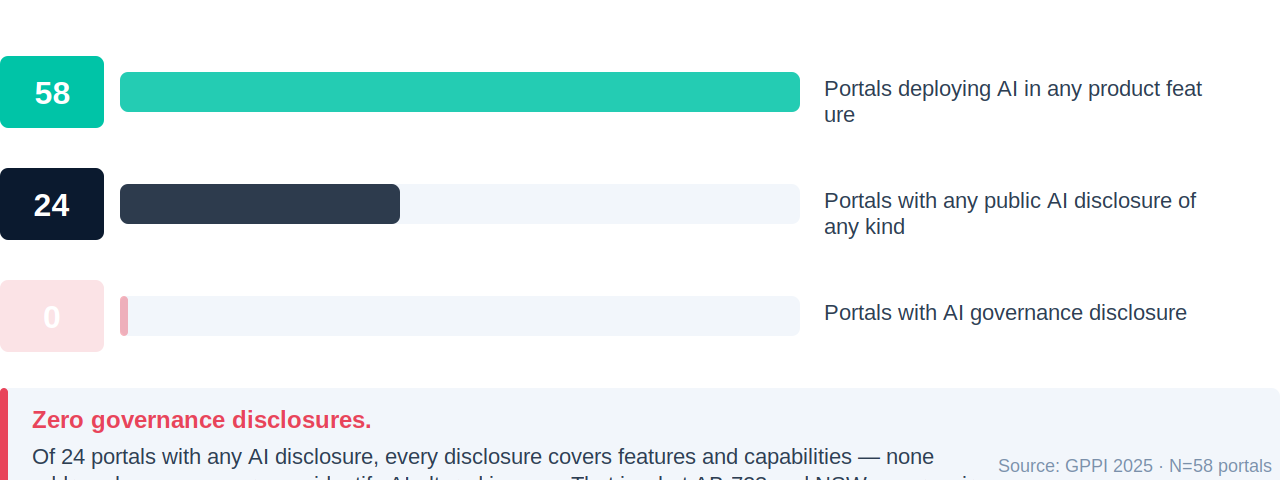
- All 58 portals benchmarked in the GPPI 2025 deploy AI in product features. Zero have a public governance framework for image disclosure.
- AB-723 (California, effective Jan 1, 2026) requires disclosure of digitally altered sales listing images and a publicly accessible link to originals.
- NSW's proposed rental photo rule targets images reasonably likely to mislead, with penalties up to $22,000 for organizations.
- The real failure mode is distribution: disclosure written on one site vanishes when images get syndicated across portals, aggregators, and social ads.
- A defensible workflow has six steps: originals archive, alteration register, portable disclosure, durable proof access, recorded sign-off, and a proof pack.
- If you build provenance discipline now, the next regulation becomes a small update. If you wait, it becomes a fire drill.
The moment it clicked
At Property Portal Watch in Madrid earlier this year, a private equity executive told me he had stopped trusting listing photos. Every place he visited looked worse than it did online. Smaller rooms, older finishes, different light. He shrugged and said: "I visit everything now regardless of what it looks like online."
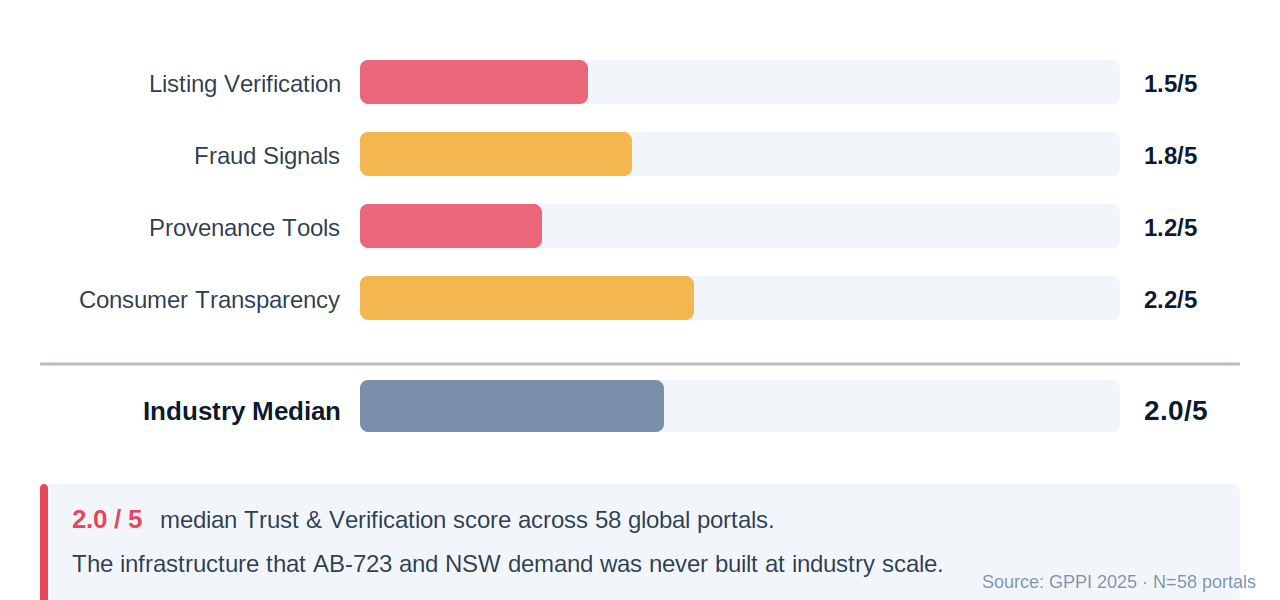
He can afford to waste weekends on false leads. Most buyers and renters cannot. That comment landed on something I had been tracking through the Global Property Portal Index (GPPI), which we publish at Coraly. The 2025 edition benchmarked 58 of the world's leading portals; the index has since expanded to over 200. Every portal we measured is using AI in some product feature. Not one has figured out how to tell consumers about it.
01. Why this is happening now
AI made misleading cheap, fast, and plausible
Ten years ago, you could feel when an image was overly edited. The tells were obvious. Surreal skies. Warped lines. Rooms that glowed like a furniture catalogue. Today the tools are different. Generative AI can remove mould and stains cleanly, swap views through windows, add skylights, stage rooms with furniture that was never there, and shift proportions just enough to matter. None of it looks fake.
And agents are using these tools. Widely. It is not a fringe behaviour. AI photo enhancement has become a standard part of listing preparation across most markets. The speed is remarkable: what used to take a professional editor an hour now takes an app thirty seconds.
In real estate, an image is not just a vibe. It is evidence. People make high-stakes decisions based on photos: which homes to inspect, which rentals to apply for, which properties are worth the commute. When the gap between the photo and the property gets too wide, you do not just have a disappointed buyer. You have a misleading advertisement.
Regulators noticed. And they responded the way they always have with new technology: by treating altered images the way they treat other advertising claims. If it can change expectations, it must not mislead. In some cases, you must disclose. In Australia, consumer regulators already treat images and descriptions as part of what must be accurate.
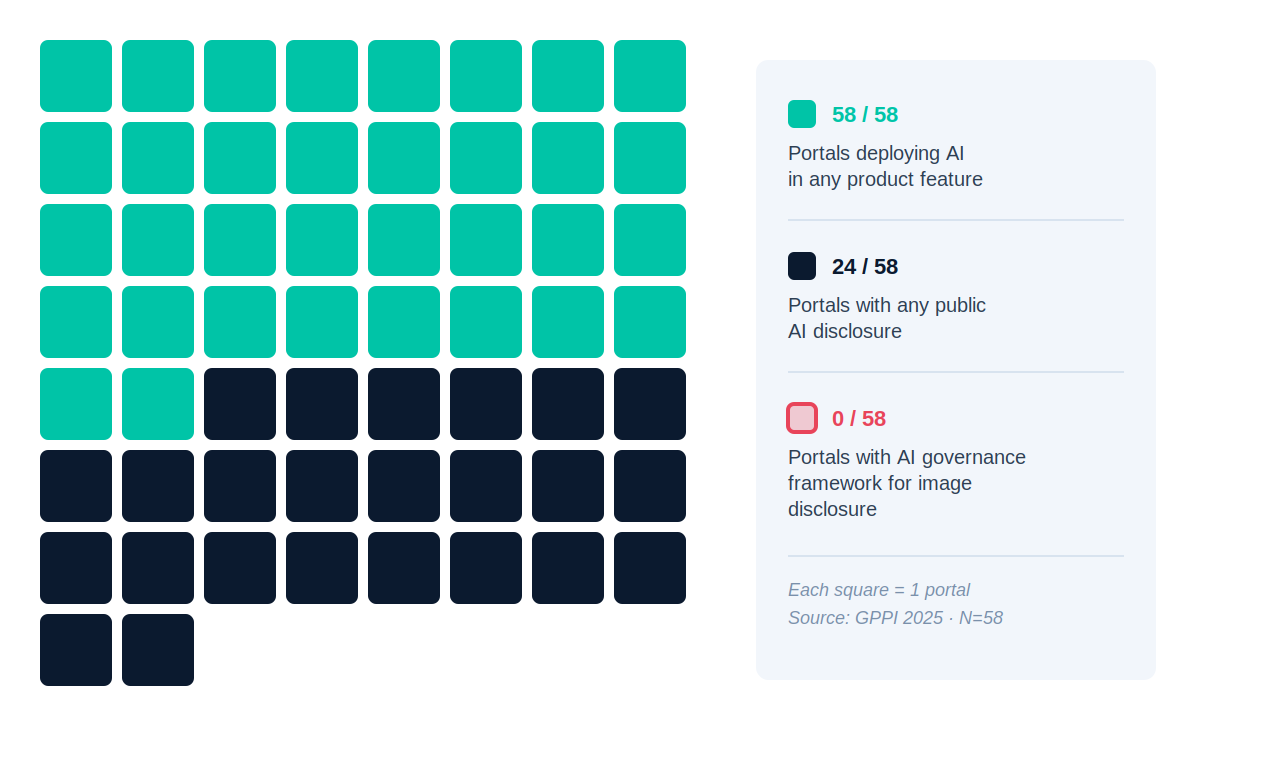
That chart is worth sitting with. Every portal we measured is deploying AI. Twenty-four have some kind of public AI disclosure. But when we looked at what those disclosures actually say, none of them mention governance, accountability, or how consumers can identify AI-altered images. Governance framework, for our purposes, meant a publicly documented policy covering image alteration disclosure, consumer visibility, and access to originals. Regulators are not reacting to a future risk. They are responding to a present gap.
02. Two jurisdictions, one message
Image governance is now part of the job
California and New South Wales came at this from opposite directions. California focused on sales listings. NSW focused on rentals. They landed on the same conclusion: if an image can change a high-stakes decision, its provenance has to be disclosed and provable. An important distinction: AB-723 does not prohibit digital alteration. It requires conspicuous disclosure and access to the original when material changes are made. The regulation targets transparency, not the technology itself.
| Dimension | California (AB-723) | New South Wales (Rental Photo Rule) |
|---|---|---|
| Focus | Sales listings | Rental listings |
| Trigger | Digitally altered images (AI edits that add, remove, or change fixtures, furniture, landscaping, facades, floor plans, views) | Digitally generated or altered images reasonably likely to mislead |
| Requirement | Conspicuous disclosure on or adjacent to the image, plus a publicly accessible link/URL/QR to the original unaltered image | Disclosure that images are digitally generated or altered. Secretary may issue guidelines on 'misleading' threshold. |
| Excluded | Lighting, sharpening, white balance, cropping, exposure | TBD (guidelines pending) |
| Penalties | Professional licensing consequences | $5,500 (individuals), $22,000 (organisations) |
| Defence | N/A | Available for agents who could not reasonably have known |
| Status | Chaptered Oct 10, 2025. Effective Jan 1, 2026. | Bill in progress. Legislative Council referred to committee. |
03. The hidden failure mode
Compliance breaks in the distribution chain
The headlines focus on disclosure. The real failure mode is distribution.
Say you write the perfect disclosure sentence. It appears on your website, right next to the image, exactly as the law requires. Then the image gets syndicated to three portals, two aggregators, and a social ad campaign. The disclosure vanishes. Nobody stripped it out on purpose. The systems just were not built to carry it.
Real-estate images travel. MLS uploads, portals and syndication partners, agency sites, social ads, PDFs and brochures, inspection booking pages, rental alert aggregators, developer microsites. In Australia, which does not have a single nationwide MLS spine, this gets especially complicated. But the same truth applies everywhere: images get duplicated, resized, re-exported, and re-uploaded constantly.
So the compliance object is not the image itself. It is the relationship between four things: the original, the altered output, the disclosure shown to the consumer, and proof that this relationship survived every placement. Break any one of those links and you have a gap.
04. The practical standard
A workflow that actually works
You do not need an enterprise compliance overhaul. You need a workflow you can repeat on every listing without heroics, one that holds up under both AB-723's proof-access requirements and NSW's "reasonably likely to mislead" standard.
Whether you use a third-party compliance tool or build the workflow internally, these six steps are the foundation.
Step 1: Make originals delivery non-negotiable
This is where most teams fail first. The photographer has the originals, the agency assumes someone saved them, and six months later nobody can find them. Every marketed listing needs a timestamped originals archive controlled by the brokerage. Here is the test: can someone other than the uploader retrieve originals for any active listing within 15 minutes?
Step 2: Maintain an alteration register per property
Which images were altered or generated? What changed: staging, object removal, defect concealment, view modification? Who did it? Does it cross the "reasonably likely to mislead" threshold (NSW) or fall inside the "digitally altered image" definition (California)? If nobody can answer these questions for a listing that goes live tomorrow, you have a gap.
Step 3: Make disclosure portable
This is the one nobody thinks about until it breaks. You write a perfect disclosure sentence. It shows up on your website. Then the image gets syndicated to three portals, two aggregators, and a social ad. The disclosure vanishes. Put it in the first lines of the description, where previews pick it up. Include it in brochure templates. Where possible, put it on the image itself.
Step 4: Provide durable proof access
California is explicit: a link, URL, or QR code that clearly identifies the original. One stable destination per listing that pairs each edited image to its original. The key word is durable. Links die. QR codes rot. Governance has to outlast the marketing cycle.
Step 5: Record sign-off
Move from "looks good" on Slack to a lightweight but documented approval. Who reviewed? What did they review: originals, finals, alteration register, disclosure placement? When? It does not need to be heavy. It needs to be attributable.
Step 6: Build a proof pack you can produce on demand
Think of it like incident response for media. Originals, edited outputs, alteration register, screenshots showing where the disclosure appeared publicly. This answers the question regulators, journalists, and consumers are all converging on: show me what was real, what was changed, and how you told people.
05. What different players should do
Broker and agency leaders
Start by drawing the line between basic enhancements (lighting, sharpening, white balance, the things AB-723 explicitly excludes) and digitally altered or AI-generated changes that trigger disclosure and proof obligations. Define which edits are prohibited outright: anything that conceals defects or creates false impressions. Make originals and an alteration map part of your listing intake checklist. And train your teams on this: "reasonable likelihood to mislead" is about overall impression, not individual pixels.
Portals, marketplaces, and property platforms
NSW's ministerial release explicitly names property platforms in its policy intent. The GPPI data confirms this is warranted: across 58 platforms globally, not one has a public AI governance framework covering image disclosure, alteration attribution, or originals access. Platforms are not being asked to improve existing governance. They are being asked to build it from scratch, under regulatory time pressure.
Photographers, editors, and AI staging vendors
You are now part of a regulated workflow, whether you realised it or not. Provide originals as a standard deliverable. Provide a basic change log showing before and after, plus what changed. And steer clear of edits that conceal faults. That is the highest-risk category in NSW's framing and the most obvious target everywhere else.
Developers and landlords
"Let the agent handle it" is not a safe strategy when your assets feed multiple channels simultaneously. Keep your own originals archive. Establish an editing policy before distribution. Require your vendors to support auditability. The liability does not disappear just because you delegated the listing.
06. Why waiting is the wrong strategy
The gap is already systemic
AB-723 and NSW's proposed section 22B are two versions of the same regulatory instinct: AI lowered the cost of deception, so proof and disclosure become the counterweight. And even where there is no AI-specific rule, general consumer protection law already covers misleading impressions, including visual ones.
The regulatory timeline
| Date | Event |
|---|---|
| 2024 (Ongoing) | AI staging tools go mainstream globally. Virtual staging, photo enhancement, and AI listing creation become standard offerings across all markets. |
| June 29, 2025 | NSW Ministerial Release (Australia). NSW Government announces intent to mandate disclosure when rental images are altered to conceal faults. Penalties: $5,500 / $22,000. |
| October 10, 2025 | California AB-723 Chaptered (USA). AB-723 signed into law. Section 10140.8 requires disclosure and publicly accessible link to original unaltered image. |
| January 1, 2026 | AB-723 Takes Effect (USA). California licensees required to comply. Multiple MLSs have operationalised compliance frameworks. |
| 2025-2026 | NSW Bill in Legislative Council (Australia). Residential Tenancies Amendment Bill referred to committee. Guidelines on the "misleading" threshold to be issued. |
| 2026 Onwards | Other jurisdictions watching. Consumer protection law in most markets already covers misleading impressions from advertising. AI-specific rules follow the same pattern. |
The pattern is clear. If you build provenance discipline now, the next regulation becomes a small update. If you wait, it becomes a fire drill.
Quick gut-check before you publish
Works in California, NSW, and everywhere else.
- Do we have originals in hand? Timestamped, stored by brokerage, not "the photographer probably has them."
- Can someone else identify which images were altered without calling the agent, PM, or vendor?
- Is disclosure present in every placement that matters (portal, site, PDF, social)? Not just one of them.
- If someone asks for proof, can we produce it in 15 minutes? Not 15 days.
Sources and references
This article is for informational purposes only and is not legal advice. Consult your legal counsel, follow your Multiple Listing Service (MLS) and portal rules, and monitor regulator guidance and commencement details.
- California Assembly Bill 723 (AB-723). Business and Professions Code Section 10140.8.
- NSW Government Ministerial Release on Rental Photo Disclosure (June 29, 2025).
- Global Property Portal Index (GPPI) 2025. Coraly. N=58 portals.
- NSW Residential Tenancies Amendment Bill. Legislative Council committee referral.
- Various consumer protection frameworks covering misleading advertising in property markets.